 The EUREQA dataset
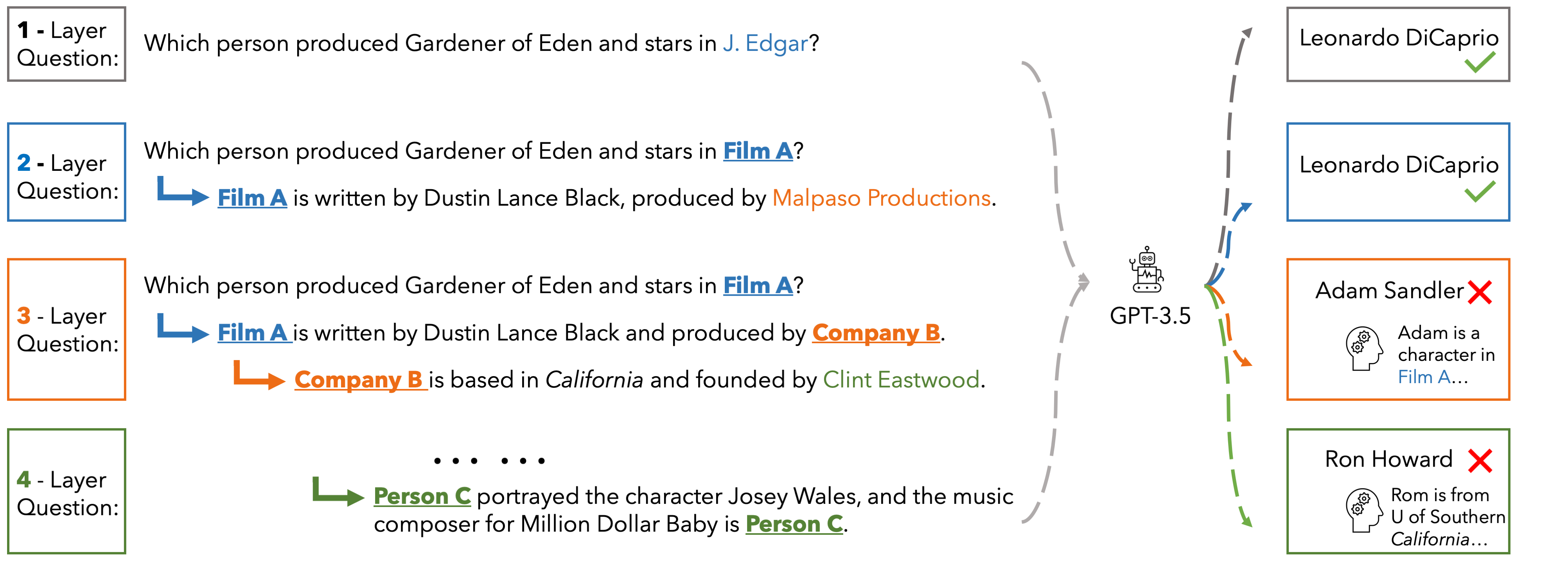
In EUREQA, every question is constructed through an implicit reasoning chain. The chain is constructed by parsing DBPedia. Each layer comprises three components: an entity, a fact about the entity, and a relation between the entity
and its counterpart from the next layer. The layers stack up to create chains with different depths of reasoning. We verbalize reasoning chains into natural sentences and anonymize the entity of each layer to create the question.
Questions can be solved layer by layer and each layer is guaranteed a unique answer. EUREQA is not a knowledge game: we adopt a knowledge filtering process that ensures that most LLMs have sufficient world knowledge to answer our questions.
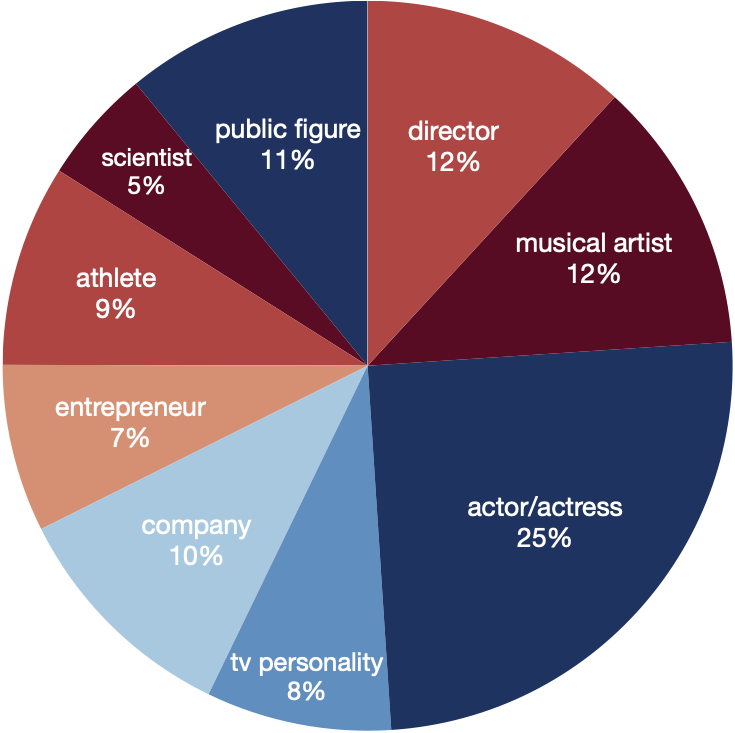
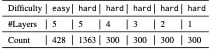
EUREQA comprises a total of 2,991 questions of different reasoning depths and difficulties. The entities encompass a broad spectrum of topics, effectively reducing any potential bias arising from specific entity categories.
These data are great for analyzing the reasoning processes of LLMs
 Performance
Here we present the accuracy of ChatGPT, Gemini-Pro and GPT-4 on the hard set of EUREQA across different depths d of reasoning (number of layers in the questions). We evaluate two prompt strategies: direct zero-shot prompt and ICL with two examples. In general, with the entities recursively substituted by the descriptions of reasoning chaining layers, and therefore eliminating surface-level semantic cues, these models generate more incorrect answers. When the reasoning depth increases from one to five on hard questions, there is a notable decline in performance for all models. This finding underscores the significant impact that semantic shortcuts have on the accuracy of responses, and it also indicates that GPT-4 is considerably more capable of identifying and taking advantage of these shortcuts.
| depth | d=1 | d=2 | d=3 | d=4 | d=5 | |||||
| direct | icl | direct | icl | direct | icl | direct | icl | direct | icl | |
| ChatGPT | 22.3 | 53.3 | 7.0 | 40.0 | 5.0 | 39.2 | 3.7 | 39.3 | 7.2 | 39.0 |
| Gemini-Pro | 45.0 | 49.3 | 29.5 | 23.5 | 27.3 | 28.6 | 25.7 | 24.3 | 17.2 | 21.5 |
| GPT-4 | 60.3 | 76.0 | 50.0 | 63.7 | 51.3 | 61.7 | 52.7 | 63.7 | 46.9 | 61.9 |
(e.g., 9970 ) — This establishes your baseline.
ODIS Engineering itself is just the application software, but its true power lies in the —often called Flashdaten—which are the factory firmware packages for vehicle control units. These files are the raw, official firmware from VAG used to program, update, or repair modules like the Engine Control Unit (ECU), Transmission Control Unit (TCU), instrument cluster, and various other electronic systems.
Download the compressed packages (often multiple parts). Flash file collections can be very large, sometimes exceeding 184GB or even 329GB for the most comprehensive archives. Be prepared to use a large external hard drive if you choose to store the entire archive. odis engineering flash files download
Ensure your diagnostic laptop is plugged into mains power, and sleep mode, screensavers, and automatic Windows updates are fully disabled.
Click Local Flash Data and select the downloaded file matching your part number. Download the compressed packages (often multiple parts)
If you're unable to find the required ODIS engineering flash files on the official website, you can try the following alternative sources:
What is the you are working on?
ODIS Engineering is a specialized software used for diagnostics and module programming for VAG group vehicles (VW, Audi, Skoda, Seat). While the software itself is powerful, its true utility comes from "Flash Files" (SGO, FRF, or ODX files) which contain the actual firmware updates for control units like the engine, transmission, or ABS. 🚗 The Scene: A Stuttering Gearbox
ODIS Engineering is the offboard diagnostic information system used by the Volkswagen Group for engineering, development, and advanced repair tasks. Unlike its counterpart, ODIS Service, which is used in dealerships for guided diagnostics, the Engineering version is a more open and powerful platform designed for non-diagnostic and test-bench environments. Ensure your diagnostic laptop is plugged into mains
In the path, browse and select your VAG_Flash folder.
This website is adapted from Nerfies, UniversalNER and LLaVA, licensed under a Creative Commons Attribution-ShareAlike 4.0 International License. We thank the LLaMA team for giving us access to their models.
Usage and License Notices: The data abd code is intended and licensed for research use only. They are also restricted to uses that follow the license agreement of LLaMA, ChatGPT, and the original dataset used in the benchmark. The dataset is CC BY NC 4.0 (allowing only non-commercial use) and models trained using the dataset should not be used outside of research purposes.