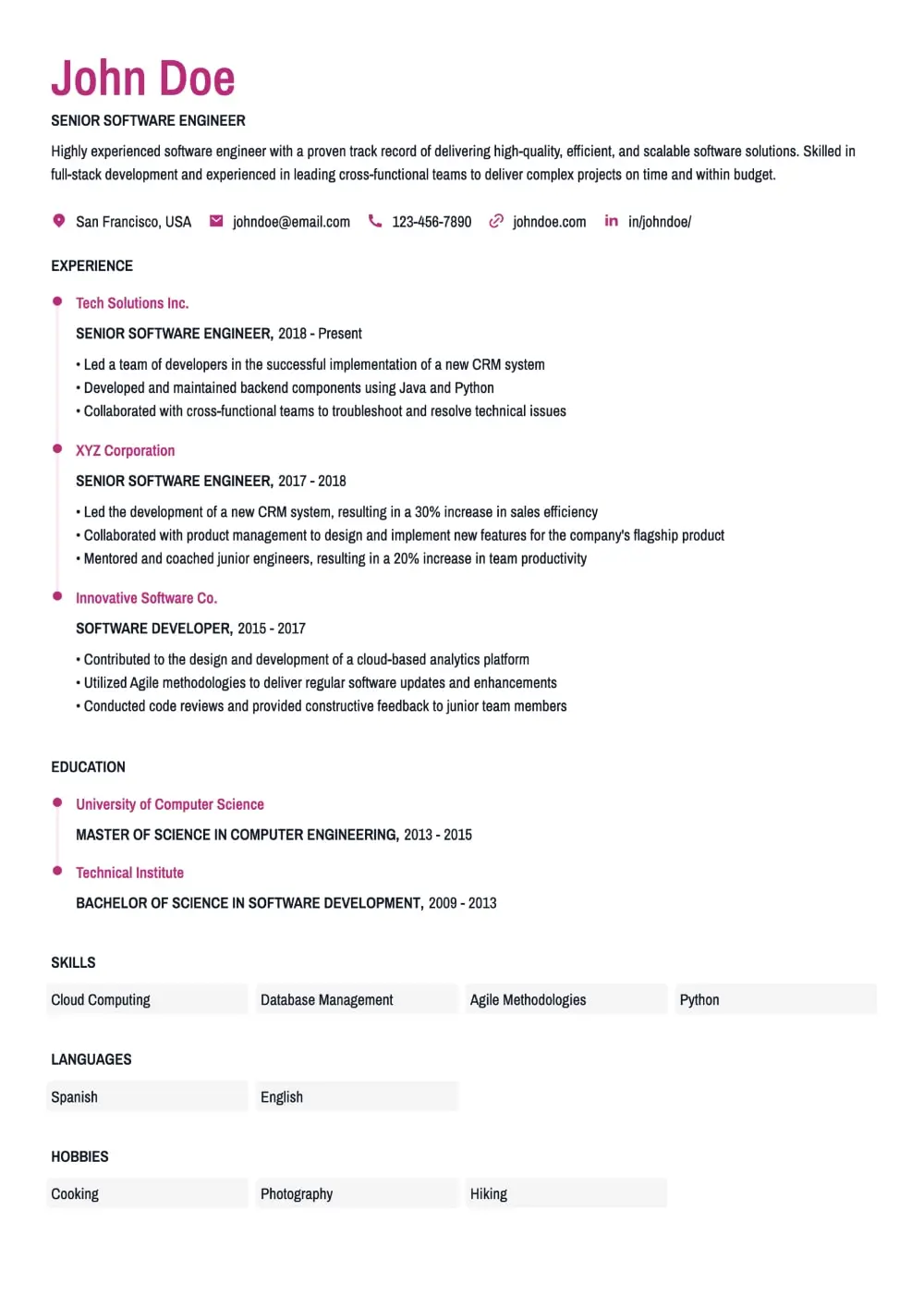
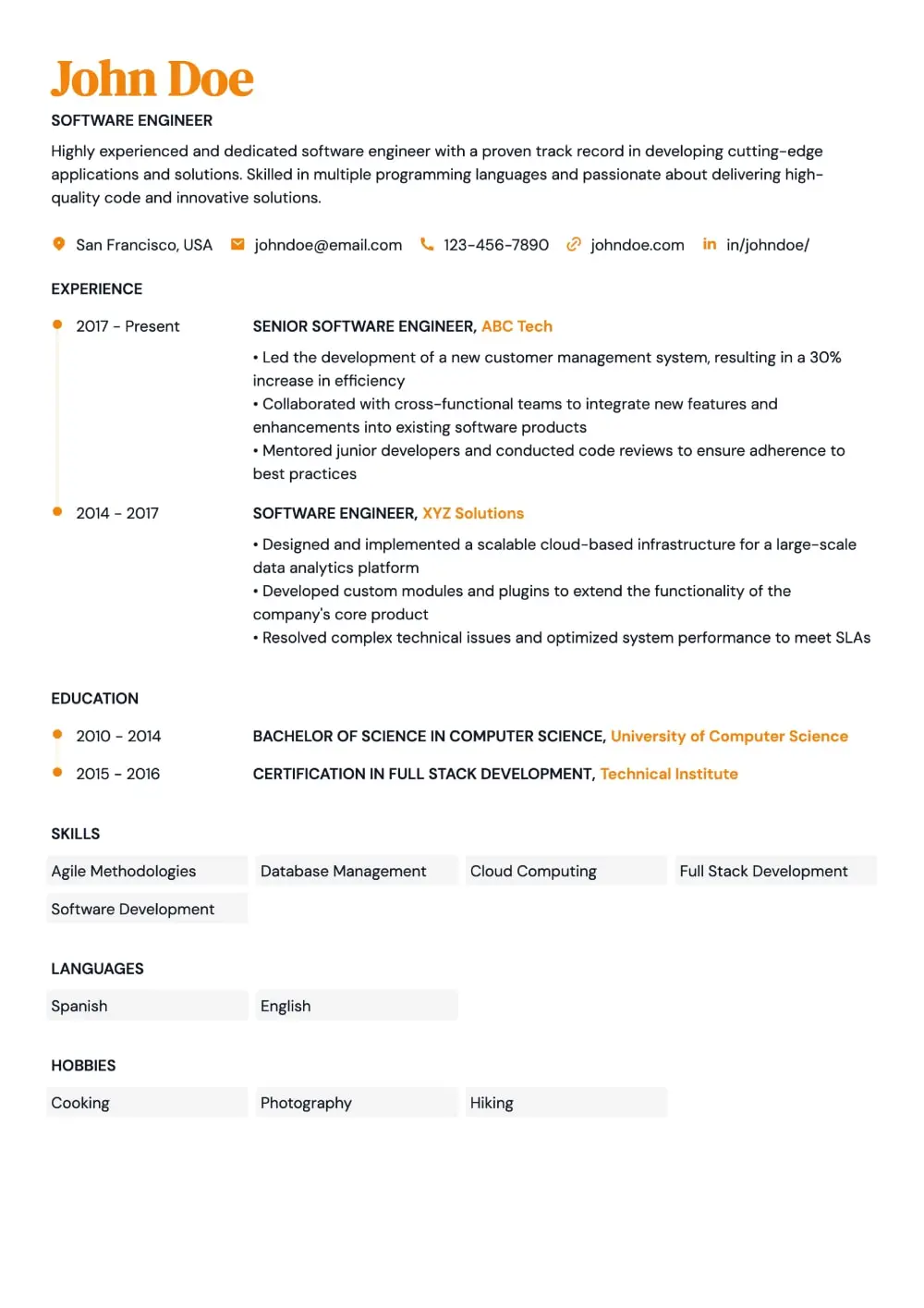
AI at your fingertips: improve, rewrite, shorten, or expand any section of your resume with one click. Instant polish, no guesswork.
Just enter your job title and get a curated list of high-impact bullet points you can pick and apply instantly.
Type your role and choose from tailored summaries and hard skills—perfectly phrased and ready to drop into your resume.
Upload your old resume and our AI will extract, clean up, and modernise it—no need to start from scratch.
Paste the job ad for your dream role and get a CV tailored to it and increase your chances of getting hired.
Create your perfect resume for free. Pay a small fee to download when you’re ready to apply with confidence.
We make sure your CV plays nice with Applicant Tracking Systems, so it gets through the filters and seen by real decision-makers.
Your data stays with you. We don't store your resume information; all of it is saved locally on your device for your peace of mind.
Forget those other complex, time-consuming resume builders. With us, dive right into creating your resume – just easy, quick resume building.
: Attackers rely heavily on specialized cyber-reconnaissance search engines like Shodan, Censys, and Zoomeye, or alternative search engines like DuckDuckGo and Bing, which may have looser scraping protections.
The keyword "inurl:indexphpid" has been a topic of interest among webmasters, SEO experts, and cybersecurity professionals for quite some time. This seemingly cryptic phrase is often associated with website vulnerabilities, search engine optimization (SEO) techniques, and potential security threats. In this article, we will delve into the world of "inurl:indexphpid," exploring its meaning, implications, and the various contexts in which it is used.
A WAF acts as a shield between your website and the internet. It analyzes incoming traffic and blocks requests containing common SQL injection payloads or automated scraping behaviors, stopping the attack before it ever reaches your PHP code. Conclusion
: This is the most effective defense against SQL injection, ensuring that user input is never interpreted as a SQL command.
The string inurl:index.php?id= remains one of the most classic footprints in web security history. While it represents standard web functionality, its visibility via search engines makes it a frequent starting point for cyber threats. By adopting parameterized queries, restricting search engine indexing on sensitive parameters, and actively monitoring web traffic, organizations can effectively close the door on dork-driven exploits.
The tester adds a single quote to the URL: https://example.com/index.php?id=5'
If the web application does not properly sanitize or validate the input provided in the URL, an attacker can manipulate the query. For instance, they might change the URL to: ://example.com OR 1=1 Use code with caution. If vulnerable, the server executes: SELECT * FROM articles WHERE id = 10 OR 1=1; Use code with caution.
Prevent SQL injection vulnerabilities in PHP applications and fix them
Once a potentially vulnerable URL is found, ethical hackers often test it using a simple ' (single quote) at the end of the URL to see if a database error is returned, which indicates a potential vulnerability. 4. Dangers and Ethical Considerations
You might think, “Surely nobody writes code like that anymore.” You would be wrong. Here is why inurl:index.php?id= remains relevant:
Avoid using functions like mysql_real_escape_string() as a primary defense; escaping is not reliable for every scenario.
: Attackers rely heavily on specialized cyber-reconnaissance search engines like Shodan, Censys, and Zoomeye, or alternative search engines like DuckDuckGo and Bing, which may have looser scraping protections.
The keyword "inurl:indexphpid" has been a topic of interest among webmasters, SEO experts, and cybersecurity professionals for quite some time. This seemingly cryptic phrase is often associated with website vulnerabilities, search engine optimization (SEO) techniques, and potential security threats. In this article, we will delve into the world of "inurl:indexphpid," exploring its meaning, implications, and the various contexts in which it is used.
A WAF acts as a shield between your website and the internet. It analyzes incoming traffic and blocks requests containing common SQL injection payloads or automated scraping behaviors, stopping the attack before it ever reaches your PHP code. Conclusion inurl indexphpid
: This is the most effective defense against SQL injection, ensuring that user input is never interpreted as a SQL command.
The string inurl:index.php?id= remains one of the most classic footprints in web security history. While it represents standard web functionality, its visibility via search engines makes it a frequent starting point for cyber threats. By adopting parameterized queries, restricting search engine indexing on sensitive parameters, and actively monitoring web traffic, organizations can effectively close the door on dork-driven exploits. In this article, we will delve into the
The tester adds a single quote to the URL: https://example.com/index.php?id=5'
If the web application does not properly sanitize or validate the input provided in the URL, an attacker can manipulate the query. For instance, they might change the URL to: ://example.com OR 1=1 Use code with caution. If vulnerable, the server executes: SELECT * FROM articles WHERE id = 10 OR 1=1; Use code with caution. Conclusion : This is the most effective defense
Prevent SQL injection vulnerabilities in PHP applications and fix them
Once a potentially vulnerable URL is found, ethical hackers often test it using a simple ' (single quote) at the end of the URL to see if a database error is returned, which indicates a potential vulnerability. 4. Dangers and Ethical Considerations
You might think, “Surely nobody writes code like that anymore.” You would be wrong. Here is why inurl:index.php?id= remains relevant:
Avoid using functions like mysql_real_escape_string() as a primary defense; escaping is not reliable for every scenario.